
I am a Meta-Architect
For years, my passion for optimizing processes and creating tools didn't fit into any job description. Today, I'm giving that role a name and a definition. In my new blog post, I explore what it means to be a "Meta-Architect." I invite you to read it and share your thoughts.
Rafael Molina
8/21/20252 min read

I am a Meta-Architect
For years, I felt that I didn't quite fit into the professional labels of the architecture and construction world. I moved through different positions, and although I found opportunities to contribute and excel in each one, there was always an underlying drive that wasn't part of the official job description. A quiet obsession that followed me on every project: the relentless pursuit of optimization.
It didn't matter if the title was Designer, Coordinator, or BIM Manager; my true motivation emerged whenever I detected an inefficient process. I always saw a pattern, a common thread that connected every role: the opportunity to create tools that helped do things better. My passion wasn't just in the final result, but in redesigning the path to get there. In building the spreadsheet that saved hours of work, in programming the add-in that eliminated a repetitive task, in defining a workflow that made everything faster, easier, and more powerful.
For a long time, I didn't have a name for this role. It was simply "what I do." Until I found a concept that finally made sense of it all. A definition that encompasses not just my work, but my professional identity.
Below, I share what it means to me to be a Meta-Architect.
In conventional architecture, we obsess over the "what": the building, the form, the material. But the most critical question—the one that defines a project's success or failure before the first stone is laid—is the "how." How do we collaborate? How do we manage complexity? How do we turn a vision into reality without the friction of the process causing it to disintegrate?
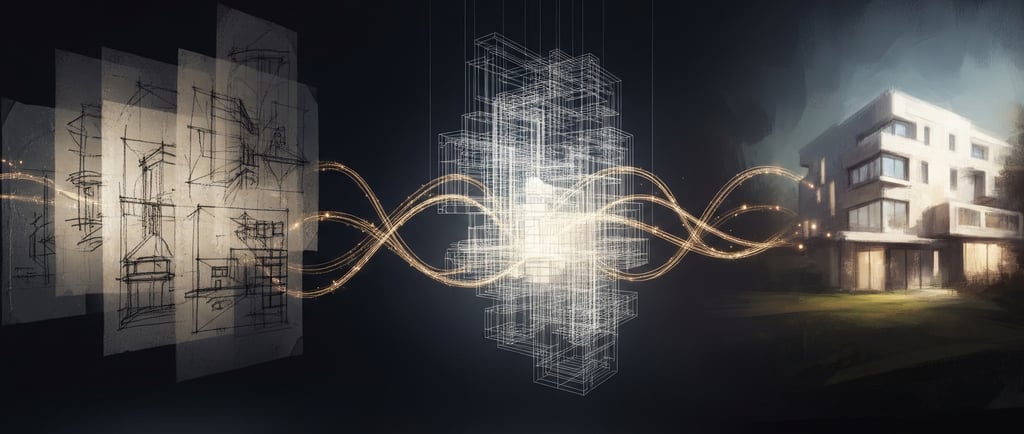
That is where my role begins. I don't design the building; I design the system that enables its design.
I define myself as a Meta-Architect. A term that describes someone who steps back from the architectural object to design something more abstract and powerful: the ecosystem where architecture is born. My focus is not on the brick, but on the flow of information; not on the beam, but on the decision-making process. As a Meta-Architect, my job is to be the "architect of architects": I create the frameworks, tools, and methodologies that allow design teams to reach their full potential, building better buildings, faster, and with greater simplicity.
This is not just a profession; it's an identity. I am an Automaton. A relentless optimizer who finds refuge and purpose in the logic of code and the elegance of a seamless process. My mindset is to dismantle complex systems to their core, understand their flaws, and rebuild them to be simple, efficient, and robust. This drive leads me to develop add-ins for Revit, create smart templates, or design any tool that transforms a repetitive, tedious task into an automated and invisible workflow.
In practice, being a Meta-Architect with the mind of an Automaton translates into two specific roles:
Workflow Architect: I map, analyze, and redesign every step a team takes. I eliminate bottlenecks, automate communication, and build the data highways on which projects travel.
Designer of Simplicity: My ultimate goal is to take something incredibly complex and make it feel simple. The best tool is not the one with the most features, but the one that requires the least effort to generate the greatest impact. I transform overwhelming complexity into powerful simplicity.
My work isn't seen in the finished buildings, but in the calm of the teams that design them. It's felt in the time saved, the errors avoided, and the energy freed up so that architects can get back to what they do best: creating.
I don't build architecture. I build the smartest way to create it.